
Category Archives: Opinion
Meanwhile in America: The Second Gilded Age
Has America Become an Oligarchy?
By Thomas Schulz
At first, the outraged members of the Occupy Wall Street movement in New York were mainly met with ridicule. They didn’t seem to stand a chance and were judged incapable of going up against their adversaries, Wall Street’s bankers and financial managers, either intellectually or in terms of economic knowledge.
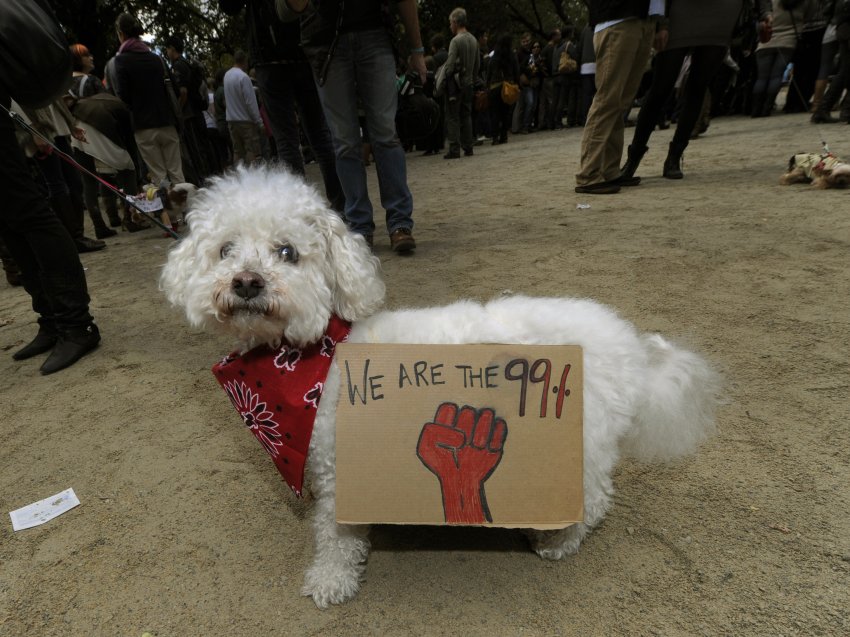
“We are the 99 percent,” is the continuing chant of the protestors, who are now in their seventh week of marching through the streets of Manhattan. And, surprisingly, they have hit upon the crux of America’s problems with precisely this sentence. Indeed, they have given shape to a development in the country that has been growing more acute for decades, one that numerous academics and experts have tried to analyze elsewhere in lengthy books and essays. It’s a development so profound and revolutionary that it has shaken the world’s most powerful nation to its core.
Inequality in America is greater than it has been in almost a century. Those fortunate enough to belong to the 1 percent, made up of the super-rich, stand on one side of the divide; the remaining 99 percent on the other. Even for a country that has always accepted opposite extremes as part of its identity, the chasm has simply grown too vast.
A New ‘Gilded Age’
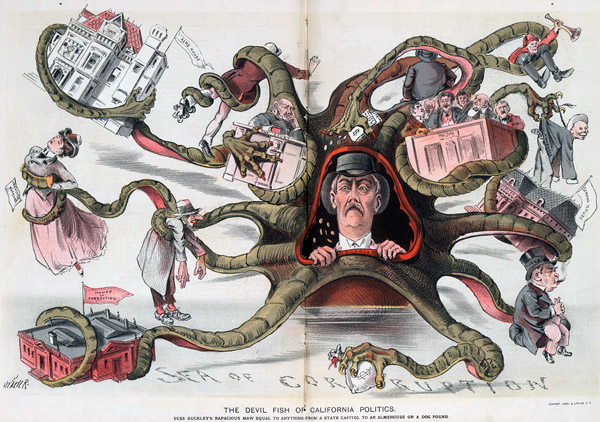
In a book published in 2010, American political scientists Jacob Hacker and Paul Pierson discuss how this “hyperconcentration of economic gains at the top” also existed in the United States in the early 20th century, when industrial magnates — such as John D. Rockefeller, Andrew Carnegie and J. P. Morgan — dominated the upper stratum of society and held the country firmly in their grip for years.
Writer Mark Twain coined the phrase “the Gilded Age” to describe that period of rapid growth, a time when the dazzling exterior of American life actually concealed mass unemployment, poverty and a society ripped in two.
Economists and political scientists believe the US has entered a new Gilded Age, a period of systematic inequality dominated by a new class of super-rich. The only difference is that, this time around, the super-rich are hedge fund managers and financial magnates instead of oil and rail barons.
Read full article at: Spiegel Online
Social Pain







Patterns


Going Home

Ai Weiwei for W magazine





via: www.wmagazine.com
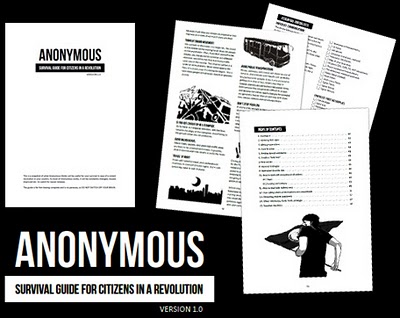
Anonymous: Survival Guide for Citizens in a Revolution

via: Anonymous Hamburg | mischief | mudkipz | lulz
Download Link: http://www.multiupload.com/1GA9HET58U
World bank teams up with Nestlé to privatize the world’s water country by country.
RELEASE: World Bank partners with Nestlé to “transform water sector”
New venture aims to privatize water country by country
For Immediate Release:
October 25, 2011
Contact:
John Skinner, 617-695-2525
[WASHINGTON, DC]: Today, the World Bank launched a new partnership with global corporations including Nestlé, Coca-Cola and Veolia. Housed at the World Bank’s International Finance Corporation (IFC), the new venture aspires to “transform the water sector” by inserting the corporate sector into what has historically been a public service. The new partnership is part of a broader trend of industry collusion to influence global water policy.
The venture — called the 2030 Water Resources Group Phase 2 Entity — aligns global corporations that have major financial stakes in water governance with the World Bank, one of the world’s leading development institutions. Nestlé Chairman Peter Brabeck-Letmathe has been appointed to chair the Water Resources Group, which has already received $1.5 million in IFC funding. Nestlé is the world’s largest water bottling corporation.
Advocates for people’s access to water point to this as the latest example of water corporations’ efforts to interfere in legitimate, democratic water governance. The Water Resources Group presents a conflict of interest to the World Bank’s goal of poverty alleviation. It also advances an approach to water governance that is in incompatible with the U.N. recognized human right to water.
“This is an unmistakably activist campaign by the private water industry to gain funding and credibility for a radical power grab, with the help of the World Bank,” said Corporate Accountability International’s Senior Organizer Shayda Edwards Naficy. “According to the World Bank, 34% of private water contracts are in distress or terminated before maturity. Last April, the IFC’s Compliance Advisor Ombudsman reported that an astounding 40 percent of complaints received from all regions and sectors were water-related. This is evidence that water privatization has been fraught with a range of problems, including broken promises for expanded service, wasted public funds and threats to human rights, especially for the lowest income families. For the Bank to sanction this approach despite a track record of failure points to compromised decision-making at the Bank due to pervasive partnerships with and financial stakes in corporations.”
Currently, 90 percent of the world’s water-users access water through public delivery. Turning these systems over to private corporations would result in rate hikes, cutoffs and significant layoffs of water sector employees. Focusing on the private sector also distracts from the need to support governments in protecting human rights.
The Water Resources Group aims to “develop new normative approaches to water management,” paving the way for an expanded private sector role into best and common practices, worldwide. In order to be eligible for support from this new fund, all projects must “provide for at least one partner from the private sector,” not simply as a charitable funder, but “as part of its operations.” The group’s strategy is to insert the private sector into water management one country at a time, through a combination of industry-funded research and direct partnerships with government agencies. Currently, the Water Resources Group is formally working with the governments of Jordan, Mexico, and the Indian state of Karnataka, and discussions are ongoing with the governments of South Africa, China and several other countries slated for participation in the next phase.
“Corporate Accountability International has consistently demonstrated the World Bank’s inherent conflicts of interest, acting as an investor, a government advisor, an arbitrator and a public relations vehicle in support of profiteering in the water sector,” said Naficy. “Global water corporations must not be allowed to tap into public ‘development funds’ to promote their private agenda because case after case shows that profitability and fulfillment of human rights in the water sector are at odds.”
Corporate Accountability International (formerly Infact) is a membership organization that has, for the last 34 years, successfully advanced campaigns protecting health, the environment and human rights. Through its Campaign Challenging Corporate Control of Water, Corporate Accountability International is playing a leadership role in the global movement to secure the human right to water, and people’s access to water; prevent corporate control of water; preserve and protect water resources and systems for the public good; and preserve water resources as an ecological trust.
# # #
i am the 99%

via: reddit
 BEARKILLERS